


Evan Dunfee Tokyo 2020 Interview
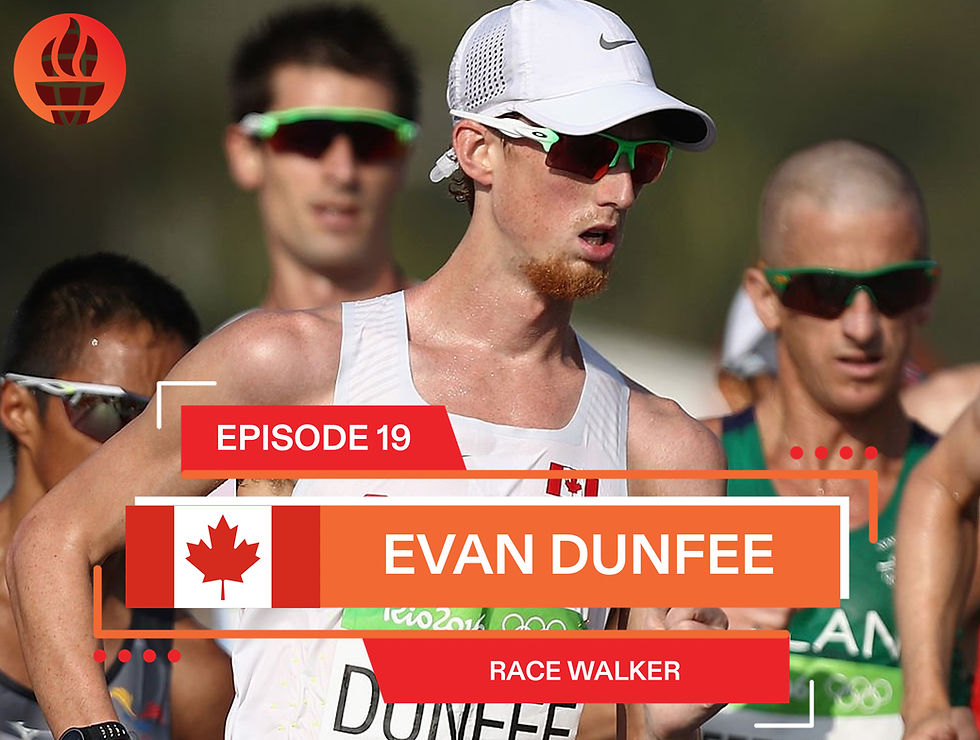
Super pumped to be able to bring you our first ever returning guest to Off The Podium today as we welcome back Canadian race walker Evan Dunfee to talk about his recent success at the Tokyo Olympics and everything else in between! We learn from Evan just what was going through his mind in the closing stages of his race that spurred him on to claim a Bronze Medal and just what it meant to him to finally have an Olympic Medal around his neck. We also learn about his advocacy and continued fight to keep his event in the Olympics and why he is so outspoken against the IOC. Added to this we talk all things Kraft Dinner and find out just why a 2032 Olympic tilt could be on the cards. It's another amazing chat with Evan that you simply won't want to miss out on!
EPISODE TRANSCRIPT
Please note this is an automated transcript that may contain errors.
COLIN HILDING: Welcome back to Off The Podium, an Olympics podcast. And for the first time ever, we get to welcome back somebody to Off The Podium. I was going to correct myself. I mean, we do welcome back Ben and Colin frequently, everyone's a while Jarrod, but I guess of important people, we get to welcome back our first ever guest, which is such a pleasure. We interviewed Evan Dunfee, who's our guest today, Olympic now Bronze Medallist in race walking. We interviewed him all the way back in Rio. And I didn't even realise it was our first interview ever. I think we did a string of interviews all within a couple of weeks there, but Evan was, you confirmed it, our first interview ever. And now 160 episodes later, somewhere around there, five years, somewhere around there later, Evan Dunfee gets to become our first ever return guest. And I feel like we should go back and amend the original interview with like a James Bond thing. Evan Dunfee will return in episode number 160.
BEN WATERWORTH: Which is interesting though.
COLIN HILDING: You heard the original interview too.
BEN WATERWORTH: Yeah, I remember when you interviewed him, I like, you know, not going into all the details. I think we did a bit on our recent 100th episode, but it's, I say recent, that was like 71 episodes ago then. But I think we kind of touched on the fact that it was never really a let's definitely do interviews. I mean, it was a nice thought, but like, I mean, the show was started kind of in a weird way and blah, did Rio. And then all of a sudden it was like, hey, we should try and get some guys on the show. And you got Evan on basically straight away. And I remember listening to it vividly. I was in the gym and listening to it and thoroughly enjoying it and really kind of getting, you know, into Evan's story. So yeah, and we always, we always offer every guest who comes on the show, like we say, hey, we'll get you back on, we'll get you back on. And clearly cause they don't really do well after being on the show cause we jinx them. We don't often get them back on the show, but this is an anomaly. And we don't even mention this in this interview, I believe that we don't even say like, hey, good to see that you won a medal. Nobody else, at least that I'm on a show with wins a medal.
COLIN HILDING: I was going to say, let's, for all the listeners, the people who have been listening, at least since just before Tokyo, obviously the Off The Podium curse was a very big deal for a long time. We discovered during it that the curse was actually not off the podium. It was just Ben. The real reason we haven't done-
BEN WATERWORTH: My one bronze medal versus all your other medals. So that's, and then it was in a real, I know Australian, I'm still stuck with the no Australians won a medal since coming on the show.
COLIN HILDING: So really the real reason that Evan Dunfee's back on the show here is so that Ben can piggyback and say, you know what, I've interviewed an Olympic medallist. The curse of Ben is over now. So let's hope it's over.
BEN WATERWORTH: We'll do an episode of Entity where I'll compare thou medallist versus medallist. And I'm telling you, I'm leading the middle tally here on Off The Podium in terms of who we've interviewed so far.
COLIN HILDING: The amount you've done in the last couple of months, I'm sure you are, but without further ado, let's get to it right now. Returning to the show, the great race walker, the great advocate of his sport, the great bronze medallist, Evan Dunfee.
COLIN HILDING: Well, if you were with us from the beginning, you know, about five years ago, we started this little podcast, and about 19 episodes in, we decided, let's start talking to athletes. It might work out. And believe it or not, the first person we ever talked to was a little race walker named Evan Dunfee. And now, 160 episodes later, we have our first ever return guest on Off The Podium. Started out as number one, number one in another category. Forget about an Olympic medal. He's now the first ever return guest. But he also has the Olympic medal go along with it. We have the Olympic bronze medallist in the race walk, Evan Dunfee, returning. Evan, thanks so much for returning to Off The Podium. I've never had to say that before.
EVAN DUNFEE: Thanks so much. I'm happy to be here. I mean, so much has changed. It seems like a lifetime ago now.
COLIN HILDING: I mean, the extra year obviously adds on to that. But I mean, four years is a long time in between Olympics anyways. But the last time we talked to you was right after Tokyo. And now we've flashed forward and you're sorry, last time we talked about was after Sydney. What's a good correction there?
BEN WATERWORTH: Rio, Colin, Rio.
COLIN HILDING: We did 160 episodes in the last three weeks, but not Rio. It's Sydney, Rio, one of those games back there. But now flash forward to Tokyo. I mean, you're a bronze medallist. When you were sort of wrapping up and recovering from Rio, was the thought in your mind, Tokyo is next. And did you think that you would be able to improve your result and end up in that bronze position?
EVAN DUNFEE: Yeah, track and field. Like athletics is so, at least in my experience, it's so different. You finish up the Olympics, and everyone outside of the world of sport is telling you about four years from now, four years from now, but in your own mind, you're like, well, no, we have a world championship next year. So even coming off the back of Rio, Tokyo felt so far away. It was a few world championships, a few world racewalking championships away. And it was certainly something I knew I was going to be heading towards. But now when I look back on it, we actually had to fight to save our event in 2017, and we almost didn't get a 50K in Tokyo. And the ups and downs of coming off the fourth place from Rio and then thinking I was in that echelon of fighting for medals and then going and completely screwing up my next two world championships. And then thinking like, okay, well, maybe I'm not a medallist. I'll just, you know, I'll race for eighths. And then coming away with a Bronze Medal in Doha with that strategy and just think, oh, well, hell, I don't know anymore. I want to go out there and race and see what happens. And, you know, that was sort of the lesson I took from the five years since Rio going to Tokyo, just like, I got no idea. I'm just gonna go there and see what I can do. And haven't seen anybody else race for over a year. So who knows what other people are capable of? I'm just gonna do my thing.
BEN WATERWORTH: I wasn't on the interview back when Colin did it. And I loved listening to it and kind of loved listening to the journey and everything that happened back in Rio, the emotions over everything that happened in that race. And one of my highlights clearly of Tokyo was seeing you able to get that bronze medal, Evan, because it almost seemed like it was just destiny. You deserve that more so. I mean, everyone deserves a good result, but kind of after what happened in Rio, it was like, this is justice. This is what you needed. This is what happened. I mean, when you're standing on the podium with that medal around your neck, do you just take a moment to kind of go over that journey, kind of, you know, just take a deep breath and go, okay, whew, now people can stop asking me questions about Rio, I've got this bronze. All that hard work's paid off. You know, now let's go on to the next fight to save the event for the next games.
EVAN DUNFEE: Yeah, so funny. You talk about like, oh, it feels like it must have been destiny and something like that. And you know, when I think back to that final 2k of the race, sitting in fifth place with 2k to go, I really would have loved the positive frame in my mind of being like, no, like this medal is destiny. Like all it was in my head was, first of all, Viera, the Portis athlete, he's three seconds ahead of me. He beat me by three seconds at Worlds in 2019. You can't lose this guy by three seconds again. And managed to get ahead of him with a kilometre to go. And then it was like, oh crap, I mean, you're in fourth again. Like you can't finish fourth again. And it was completely, no sports psychologist is going to tell you, this is the framing that you should be giving yourself. But I was, you know, it was, I reflect back on those last, you know, last eight minutes or so, I was very self-deprecating. And just, you know, I would have loved to be like, come on, Evan, this is your destiny. Like you got to get this medal. It was just like, oh, come on, don't finish fourth again. That was, that was agonising last time. You can't let that happen again. So certainly that, I mean, that feeling that washed over me right away was one of, of sort of contentment. I was just kind of like that, you know, that, that, that wave of, all right, I did the thing, you know, the thing that I set out to do when I was 10 years old, I've done the thing. I, no one can ever take that away from me now. Cool. Like it was this sort of, you know, brought me up to this, instead of having this level of euphoria, it kind of just brought me up to this like level of like, I don't know how to describe it, but just this great feeling of everything feels worth it. Like everything I've done since I was 10 years old, like feels like worth it. And I think even if I hadn't won the medal, I'd still have reflected back on that in the days and weeks after the race and came to that same conclusion. But I'm pretty hard on myself. I rarely have a race where I feel good. Like I feel like I did everything I possibly could or that I didn't miss some sort of tactical move or something or other. And usually that's right away. Like to cross the finish line, I'm just like, damn, should have done this better. And that certainly came in Tokyo. You know, a couple of hours after the race, I was like, ah, crap, can I have done better? But you know, that first hour, that very first hour after I crossed the finish line, I think for the first time ever, I didn't have that. I had just this feeling of like, oh man, yeah, I did it, which was really cool to have. And then standing on the podium the next day, because our medal ceremony wasn't until the next night, they had to fly us back to Tokyo from Sapporo. And at that point in time, I, you know, as you said, reflected back on, okay, now we gotta go to fighting for, for to get our event back. And so for me, standing on the podium, the best moment for me that I get to look back on is when I got handed my medal and my flowers by two IOC executive board members. I got to look them in the eye and tell them that, you know, you made a horrible mistake getting rid of my event. And that, you know, I feel, I feel like you have to live with that decision. And to me, that was so powerful. I can yell on Twitter all day long, you know, show from the rooftops, whatever, like, no one's listening really. But to get to say it to the decision makers face to face, you know, meant just as much to me in this journey as getting to put that medal around my neck.
COLIN HILDING: And I think you said 2017 was when the talks first started, because I remember after Rio being really excited, this event's getting a lot of traction in Canada. People have a lot of interest because of you. And then it was maybe about a year, maybe year and a half later when I started seeing, I think you more than other athletes definitely were posting right away saying, hey, this is in risk. We don't know what's happening here. Do you remember how that all came about? Was it something where you kind of had the heads up beforehand? Did you know before Rio, maybe it's on the bubble or did it just completely come out of nowhere?
EVAN DUNFEE: Yeah, there's a really sketchy backdoor meeting with the IOC, or sorry, with the World Athletics IAAF at the time, Race Walking Committee where Seb Coe, the president of IAAF, World Athletics now, supposedly came in the room and put his hand down saying, we need to get rid of the event. And the Race Walking board members or committee members figured out some way to take the event off the program for Tokyo. And this was all supposed to be done behind closed doors and without any consultation. And someone leaked it and we got a hold of it. And we managed to mobilise the worldwide community of race walkers and our supporters and kind of managed to like stave off that attack. But we knew it was only a matter of time. We knew that we were only delaying the inevitable. Tokyo was supposed to be... Well, 2021 was supposed to be the last 50K. So we kind of thought we'd maybe get one more World Championships in. But no, that wasn't to be the case. And yeah, so it's been a kind of a hard fought taking away some victories over the last couple of years, but knowing that this was always going to be the route that ended up. And I've been a part of their pretend athletes engagements. And basically just were there as window dressing to say, oh, we consulted athletes and didn't listen to a word we said and use the exact same template form letter that they had written up before our meetings to submit after our meetings. And so you get pretty jaded by the whole thing. But at the end of the day, what I can hang my hat on is the performance in the show that 50K athletes put on. And it was once again, a really exciting event. And to get to be a part of that was really cool. Canada had some really big viewership numbers from what I've heard. I've heard from so many people that told me they watched it. And I was like, I still have a hard time believing that. But, you know, if that's what I can look back on and say, that's all I could do, I feel like I can hang my hat on that. And I know that the effort was there, that we tried as hard as we could to save the event.
BEN WATERWORTH: The thing that baffles me about the removal of the 50Ks, that's the one event with the most history between the 50 and the 20, right? It goes back even further than the 20. So it's interesting to me that that's the one that they're taking out. Does it come down to the fact that they want to have like a 20 and a 20, just so it's comparable between the men and women, then bring in the mixed one to keep it neutral? I mean, why is it the 50 that's going and not the 20?
EVAN DUNFEE: You're right. The 50 falls way more in line with what racewalking routes are, coming from pedestrianism, being six-day races, being a test of endurance, and the 50K being the longest foot race at the Olympics, matched as well as possible that same ideal of the ability to endure. The 20K isn't. The 20K is not the longest event in athletics. It's a bit more of a sprint. You don't have the same thing with athletes blowing up, mismanaging their energy usage and all this other stuff. You have athletes are going way faster. So from a judging point of view, it's a little bit more iffy. You get more slow motion replays of athletes off the ground. You get more people watching being like, well, this is stupid. You don't get that in the 50K. People might say, well, this is stupid, but these guys are crazy versus the 20K. You're like, well, this is stupid. These guys are running. So there's no good reason other than the IOC just wants to get rid of it. They don't like race walking. This is their first step in getting rid of race walking. Overall, they'll say that's because the event's too long, but they'll put four days of golf on, you know, none of their rationales make sense. They'll say it's for gender equality. We've been pushing for a women's 50K for years. We even suggested a way that would take men off, lower our quota for the men's race to give an equal quota to the women, wouldn't add a single athlete to the overall quota for the Olympics, for athletics. And they still said no. So any argument they presented has been very easily dismissed. But the IOC, the best thing they have at their disposal is their marketing and their PR, and they know how to spin things. So we're never going to win that fight, unfortunately.
BEN WATERWORTH: Did you get a sneaky chance during the closing ceremony to try and hunt down Thomas? Like you mentioned, you sort of had a few words on the phone. Were you at the closing going, great, cool, I've got a bronze medal. Where the hell is Thomas? Where is he? I need to speak to him.
EVAN DUNFEE: I did get a chance to corner Seb Coe in the airport lounge, heading back from Tokyo, and basically kind of looked at him and said, like, I know that you know that I have to tell you this. That was kind of the way of his brain. And he just kind of sat back. And like a good politician, he took his criticism in stride and said the right things and all that. So that's, you know, I can appreciate that. I know it falls on deaf ears, but you know, it's still meaningful for me to get to do it. It's like when I got to lay my shoulder into Justin Gatlin at World Champs one year. I was walking upstream and I saw him, and I put myself in a position where I could brush shoulders with him. And I spun off of him. It hurt my shoulder like hell. He probably didn't even feel it, but I felt good about myself.
BEN WATERWORTH: That's the main thing.
COLIN HILDING: I think all of us have had that same dream. I don't remember who was on CBC, but I swear I've heard this in multiple places. I think one of the funny things about your event is that you end up competing in these games where there's nobody in the stands except for other athletes. And for possibly, let's hope not, but possibly the last time, you end up being able to draw a crowd. I mean, between race walk, marathon, road race, you get the only authentic crowds in Tokyo, man. How did that feel to you? I guess for you, it must feel just like this is a regular event, but knowing how many other athletes were playing to empty venues and everything, and you get to do the most long distance, most enduring race in the entire Olympics, and you get real fans there in the stands, the sidelines, whatever it is.
EVAN DUNFEE: It's awesome for a whole number of reasons. I mean, just to have that support, and the people of Japan take to racewalking pretty well. They love endurance stuff. They love kind of weird, niche, strange stuff, and racewalking kicks both those boxes, right? So the Japanese have been always super supportive of the racewalk. And so we knew that being a free event, even if they were being told to stay away, that we're going to have a few thousand people show up. So it was really awesome to have that support along the sidelines, and certainly knowing it was possibly the last one, it was great, obviously, to put on a good show. Surprising that the Japanese didn't come away with any medals in the 50K walk, for sure. But moreover, I think the biggest thing for me, just another check mark for rationalising why I do this. Over the last couple of years, and especially the last year, so I've really come to terms with the fact that the Olympics aren't great. You know, they're not a great entity. They cause a lot of damage. They leave behind a lot of, you know, a lot of misery and displacement and debt and all the stuff that unequally affects lower income and minority people. And really had to come wrap my head around how I rationalise my position within the Olympic movement. And it's been made easier by the fact that the Race Walk is this free event that anyone can come and be three feet away from the athletes and feel the excitement, feel that, you know, I remember in 2012, I didn't make the Games and I wasn't going to go. And I decided in the last day that I had to be there to support my teammates. So booked a flight, flew out the next morning. And a day later, I was standing in front of Buckingham Palace with a crate full of beers, drinking in front of the Queen, watching my teammates achieve his dream. I remember in that moment being right there of that action, just feeling what it meant to these athletes, knowing full well that this was their dream, this was their goals, and they worked really hard to achieve this. And for me, that was also my dream. So watching them compete, it was like, yeah, why not me? Why I'm not going to be on this side of the sidelines in four years' time? But for other people showing up, who maybe sport's not necessarily their dream, but they still see these athletes and they see how hard they've worked to achieve the thing that they wanted to achieve, and they walk away being like, I can do that thing that I want to do. Why not me? Why not me? So there's that element of it, that we can have that impact on people, and then obviously we don't require any infrastructure. We require one kilometre of road to be closed off for half a day. So that, I think, long story short, I think that was what was so meaningful about having fans there for this last 50k race, is just another reminder of how I rationalise my position within the Olympic movement.
BEN WATERWORTH: It's interesting kind of hearing that take on things, because your family's got a bit of history with the Olympics, Evan. I mean, your dad coached swimmers, I believe, back in Munich. Your great uncle competed in the marathon in 1912. I believe you do a bit of work at the Richmond Olympic Oval as well. It seems like this is a big connection there through your life, but it's interesting to hear that sort of conflict that you do have with the Olympics in general.
EVAN DUNFEE: Certainly. I think the athletes, the 11,000 athletes, the several thousand pair of athletes, they're amazing. They go back in their home communities. They do a ton of good. They're role models. They're coaches. They're volunteers. They create so much value back home in their local communities. But the host cities, the destruction that gets left by the IOC and the rhetoric and dictatorship basically that is the IOC, it's hard to wrap its head around. As much as my family has that connection, we also have that connection with not really liking that aspect of it. In Munich in 1972, my dad was coaching. I don't think he'll mind me telling this story. The IOC had a fleet of cars for the coaches and officials to be available to themselves to use. So my dad got the keys to one of the cars and said, oh, sweet, can the athletes use these? And they're like, no. He's like, okay, cool. And he had a friend in Munich who had a garage. He took the car to the garage in Munich, parked the car, came back to the village, handed the keys to the team captain and said, here's where the car is parked. If any of you guys need it, go ahead. So even back then, you kind of think like, oh man, you don't really want to be like your parents. And then all of a sudden you realise that you're exactly like your parents. And my dad's stealing a car from the COC to give to the athletes. Definitely feels on brand.
BEN WATERWORTH: It was meant to happen. It was meant to be that way. There's a TV show in Australia in the lead up to the Sydney Olympics. It was called The Games. And basically it was a parody of the Sydney organising committee. I think you would really like it because it parodies corruption and things to do with the Olympics. And it's like one of the funniest episodes they get there, and they're preparing the athletics track. And they basically get there and like, yeah, we've got a problem. We've only been able to build it 94 metres, not 100 metres. And they're like, do you not see the problem with this? I could go out there right now and break the world record in the 100 metres, and I'm 52. Like this, you know, people will notice this during the Olympics. We need to fix this. So it's very funny. I don't know if you've ever heard of it or tracked it down, but it's worth a watch.
EVAN DUNFEE: I've watched the 2012 London BBC did a similar thing. It might have been BBC or Channel 4, but they did a similar sort of parody show that was fantastic. So I will hunt that down.
COLIN HILDING: I have kind of a two-part question as far as the event in Tokyo goes. One is just comment on the heat, because we kept hearing this is the hottest games ever, and we're seeing events. I know in the marathon, they had a record amount of people drop out. It must have been brutal, but especially doing an event as long as yours. I'm pretty sure you were able to start at 5.30 in the morning. I just did a half marathon, and the start time that I got was 8.30 in the morning. I remember complaining to my wife saying, if it had just been an hour earlier. I'm sure that hour makes a difference, but how bad was the heat? Whether it be at the beginning, end, in comparison, have you ever competed in an event that was as hot as that one?
EVAN DUNFEE: Doha World Championships 2019 were insane. Nothing like I've ever experienced, nothing like anyone's ever experienced before for racing. We raced at 11.30 at night to avoid the hottest part of the day, but it was still 30 degrees and 80% humidity throughout the race. Tons of people dropped out because they weren't prepared for those conditions. Myself and my teammates who were prepared for those conditions really well, did really well. I came home and stormed home to win a bronze medal at those World Championships. My teammate from Sweden won a bronze medal as well, and we were just prepared. We knew that those were the conditions, and we knew that Tokyo was going to be hot, so that's what we had been preparing for, and we had been following the science, and we had been doing all that stuff. So that was early October 2019. By November 2019, the IOC was freaking out because all these people dropped out, and they were terrified that the Olympics were going to be scenes of athletes collapsing, ignoring the fact that athletes collapse in cool conditions. It's just a product of pushing yourself to your limit, and a lot of athletes try to push themselves beyond their limit when they're on the biggest stage, and when you go beyond your limits, sometimes you collapse. Anyways, so the race walks and the marathons got moved 800 km north up to Sapporo, which for those of us who had prepared for the heat in Doha and succeeded because of it, were pretty pissed off. Athletes weren't consulted. Sapporo wasn't consulted. And World Athletics wasn't consulted. The IOC, in showing what they do, just unilaterally made this decision and then said everyone else is to fall in line. So going into Tokyo, going to the Olympics, that was kind of what we were working with. It was okay, well, we're going to be 800 km north. It's not going to be as hot. So, you know, heat's not going to be as big a factor. Fast forward to race week, which, you know, obviously we still went about preparing for as tough a conditions as possible because it's 2021 and you don't, you know, I don't believe, don't believe anywhere is incapable of getting to be 35 degrees anymore. But so race week comes and we're looking at the forecast and wouldn't you know it, the temperature on race day was going to be the exact same in Sapporo and Tokyo. So that's that was the case. So, yeah, it was a super hot day in Sapporo and I woke up with a huge smile on my face because I knew that we were prepared for it. I knew that I erased the best in those types of conditions. And certainly this time around, more athletes were prepared for those conditions than they were in Doha. And I had a lot of athletes who actually came to me and said, thank you for being so open about what worked for you in Doha because we basically just copied that. But certainly, I mean, the heat was a huge factor. And it was also something that we knew for four years was going to be a factor. And we followed the research and we did what science told us was the best thing to do and and pretty obviously succeeded because of that. So I long winded way of saying that I don't buy the excuse that the conditions were harmful. They just needed to be adjusted to. And athletes who were in potential harm for it just didn't prepare for it well enough. And that's like going into a heavyweight boxing fight as someone who's 140 pounds. It's stupid. But so, you know, I guess that's my feelings there. If there was any point in there, I don't know if there was. I kind of fell off on a tangent there.
BEN WATERWORTH: You're fitting very well into this show. It's all good.
COLIN HILDING: Well, the other thing that I noticed, I think just because the first time I was ever able to watch the race walk in its entirety start to finish, is how much fuel you guys are consuming throughout it. And can you give us kind of a ballpark figure of how much fluids you have to take and how many carbs, how long of an interval in between before you have to refuel?
EVAN DUNFEE: Well, I can give you a ballpark figure. Annoyingly, I could have given you a pinpoint figure, but one of the many knock-on effects of COVID, they decided that they weren't going to retrieve our water bottles. So normally I would have five or six bottles and I would just drink from them and we'd weigh them and we'd get them back every lap. This time around that was deemed to be unsafe for some reason. I don't really fully understand it. So we had to have 25 different water bottles. Wow. So I did my best to still follow my fuelling plan and fill my bottles up to the level I needed to and drink everything and all that stuff. So I took in about 88 grams an hour of carbs. Works out to be about, what is that? So about 350 calories an hour. Wow. About 1300 calories over the course of the race. Drank about 4 litres of fluid and then probably poured another 90 to 100 litres of fluid on top of myself.
BEN WATERWORTH: Just to put that in context, I've been keto for a while. I'm allowed to have 25 grams of carbs a day. That's crazy.
EVAN DUNFEE: Yeah, I've been there. It's not fun when you're trying to train for elite endurance performance. I can tell you that.
BEN WATERWORTH: I wanted to quickly ask, I seem to remember during the interview with Colin a few years ago, you talked about your time to my home city of Hobart being ridiculously hot when you competed. Can you compare Doha and Sapporo to the heat of Hobart? Because we're not a hot city, Evan. This is rare for us to ever get that hot. So I kind of want to hear the comparisons to hot Hobart versus hot Doha and Sapporo.
EVAN DUNFEE: I got to go back and look at what it was on the day. I do remember it was like Hobart's hottest weekend on record. And we were all trying to qualify for the Olympics in London. And it just went so horribly wrong. But even then, I think it did not compare to, you know, to the humidity that we had in Doha and Sapporo. I mean, that's what really kills you. It just makes it that much harder for your body to sweat and all that. So at least in Hobart, it was that dry heat where you were roasting, but you were able to cool yourself off pretty.
BEN WATERWORTH: If it's a weekend, I remember, would that be around 2012?
EVAN DUNFEE: Yeah, it would have been middle of February 2012.
BEN WATERWORTH: Yeah, because I think it got to about 43, and I remember that day. Anyone in Hobart remembers when it gets over 40, because it's such a rarity. And I remember having CD cases in my car melt, because I don't know how good quality the CD cases were, but it was just, it was an odd weekend. It really was. And I didn't realise there was a racewalking event on that. If I had known, I would have gone.
EVAN DUNFEE: It was a lot of fun. We were like right downtown, and it was like a Friday. I think it was the Friday night. So it was, I think we raced at like four o'clock in the afternoon. So four or five o'clock in the afternoon. So just as people were kind of rocking up to start their Friday night out, they were stumbling across this racewalk. So you had a few make-a-way.
BEN WATERWORTH: You would have been there. You would have been to go to the market the next morning too.
EVAN DUNFEE: Oh, God, yeah. I vaguely remember that actually. But we had a few guys who had clearly started their Friday night a little bit earlier, stumbling across, stumbling upon the racewalk, already half-cut, and that was entertaining.
COLIN HILDING: Ben, now is your chance to apologise for that. Come on.
BEN WATERWORTH: Well, I mean, I could apologise a lot for Hobart, but we'd be here for a while, Colin.
COLIN HILDING: You know, when I saw your event, especially leading towards the end, I believe it was after Mo Ahmed. And I kept having flashes because Mo Ahmed, he sort of was sitting around the same position. He's, you know, fifth, sixth, somewhere around there. And then he makes the sprint right at the end. And when I saw you do that, I'm like, oh, he's doing the same thing that Mohamed was doing. He was playing strategy or whatever. But then I heard interviews afterwards, and I was thinking, okay, this wasn't a strategy. This was literally you've got nothing left to do. So was there a part of you where maybe you were holding out a little bit just so that, you know, I'll have a sprint with it? Or was this like, okay, I'm out of this if I don't do something, and then you just really go for it?
EVAN DUNFEE: Yeah, I think being five seconds back with a K to go could have been strategy. Being 22 seconds back with a K to go was desperation. It was annoyingly like, you know, it was a race where I wasn't able to give everything I had erotically. Every time I tried to put in a surge, my hamstring just was not having it, just kept cramping up. And so I kept having to back off. So I knew that I had more in the tank. I had another gear if my hamstring would let me. But there's also part of me that knew that, okay, I can probably walk a kilometre on a torn hamstring. I probably can't walk five kilometres on a torn hamstring. So there was an element of with one K to go, it was kind of like, will my body let me go? And also an element of I don't really care at this point. If I cross the finish line with no hamstring left, whatever, at least I'll still get across the finish line. So I guess there was strategy in that regard of knowing the balance of knowing how far out I could be to limp home if I needed to. But for the most part, it was just like, holy crap, you have one K left. Just see what you can do. I was in Rio, I was in fourth, and made up an 18-second gap in the last 5K to pull even with Hiroki with a K to go. In Doha, coming to the last 2K, I was in fourth 30 seconds down and managed to pull that lead back with a big sprint finish. I know I'm an athlete who can have that big kick, and just that my body let me do it. But now that I look at it on paper and realise it was 22 seconds and that it wasn't until 800 metres to go that Mark Turr actually started slowing down, I still don't know how it happened. I don't know. I'm not quite sure how that worked out, but I'm thankful that my body let me drop that last kilometre in a 4.09 or something like that. And for context, our average pace was 4.37, so about 30 seconds quicker than my average for that last lap.
COLIN HILDING: And obviously, famously in Rio, you had that bump that you decided not to contest in everything. And I know you said earlier, hey, had you not medalled in Tokyo, you still would have gone home happy or whatever. But at any point did you think to yourself, you know what, if anybody bumps me in these last 100 metres here, I'm contesting at this time?
EVAN DUNFEE: You know, it's funny when in Doha, I was pretty much in the exact same spot of the race as I was in Rio when I moved into third place. And I remember thinking at a time, I'm just going to, you know, in Rio it was, I'm going to go past this athlete. I want them to hear my breath. I want them to see how strong I am and feel me go by them to actually, so it shatters them, it breaks them. That didn't work out so well. So in Doha, it was very much like, I'm going to pass this person very far away and not let them hear me coming, was the strategy I had. And so I think, yeah, that clearly was a better strategy. So I definitely went in this race with the, I'm going to pass with lots of room to spare. But a lot of people back home were worried that I was going to take myself out, because I guess on my last lap, when I came past the drinks table, I dropped my towel and nearly biffed it on it. So, you know, again, I don't remember that at the moment, being as panicky as everyone back home seemed to think it was.
COLIN HILDING: The commentator sure made a big deal out of it.
EVAN DUNFEE: I'd never be able to live it down if that had been while it cracked me.
BEN WATERWORTH: The towel, the towel incident, basically. The thing that I've loved watching, though, sort of through your social media and even just being on the other side of the world, obviously, I'm not seeing it in the Canadian perspective, but just the reaction that people have had to your medal in, Evan, and just all the fans that are obviously getting involved. And I'm sure Colin will talk a little bit more about the whole Kraft Dinner aspect of things. But I mean, has that surprised you? I mean, you got a lot of reaction after Rio, but now you've got that medal, you've kind of got this different type of reaction. I mean, how have you sort of found it coming back home and having all these people so excited to see your success there and come home with a bronze medal?
EVAN DUNFEE: It's really, really cool. I got into the sport for really selfish reasons. I wanted to be the best athlete I could be. I wanted to be the world champion in this weird little niche event that I had chosen to make my own. And for the longest time, it didn't really extend beyond that. And then obviously, I think Toronto in 2015 winning Pan Ams on home soil was really the first glimpse I had of this bigger than just me mentality and the fact that I have this platform and I can leverage that platform to do some good things. And then obviously Rio opened that door up by magnitudes of 10. And then just having the community that I've had online, whether it be on Twitter or Instagram and people that sort of followed me since Rio or that were following me before Rio, I think just really do appreciate that I'm genuinely and unabashedly me and have never tried to be anything else. And so I think the combination of that attitude or approaching it that way, and then also seeing the opportunities to make this about more than just myself and get involved with people like Kidsport, to give back to my community and to raise money and just use this platform, I think those have just kind of snowballed and built on each other and definitely culminated in the Kraft Inner Deal, which then only acted to further give me a bigger platform and, you know, just, again, that snowball falls further down the hill and gets bigger and bigger.
COLIN HILDING: Yeah, we have to talk about Kraft Dinner because it was, I think it was the morning of the opening ceremonies. I'm waiting for it to start, and I see the commercial air the first time, which if anybody hasn't seen it, try to look it up, but it's basically you walking while eating and very politely, hello. One of the great, I told them, one of the greatest, I sent the video to Ben and our other co-hosts, one of the greatest commercials I've ever seen. But I think there was so much more of a heavy presence with like major corporate sponsors with Tokyo compared to other games I've seen, but I mean, this has to be huge. I mean, you wouldn't necessarily associate Kraft Dinner with Olympics necessarily, but to have a brand that big, I mean, how did this come about? Was it something that they came to you? Did the Olympic Committee say, we want to spread some of these corporate sponsors around? Evan's a Kraft Dinner guy. You know, it just matches the brand.
EVAN DUNFEE: Essentially, it was just that. I mean, so Kraft is a COC, is a Canadian Olympic Committee partner. So, you know, they have the ability and the leverage to use all the assets that other brands can't use. But basically, it came down to, I got an email, wanting to set up a call, chat to me. I was like, this feels like a joke. It's a really niche prank, but it still feels like a prank. And basically, I got on a call with the group, and they basically said, Hey, look, like, I don't know, we think that racewalking is pretty cool. We think it's different. It's unique. But we think it has value. And more importantly, we think you as a racewalker have value. And I was kind of like, holy crap, like, all I've been trying to do for my entire career is convince people that I have value and that racewalking has value. And you're now coming to me saying that you think I have value. It was so cool. And then just the fact that it was a genuine partnership, right? Like, I grew up eating Kraft Dinner and hot dogs with my parents. And as a poor university student, you know, so many of us, we grew up on Kraft Dinner. So it's not like anything we were doing was a lie. That was a big part of it for them. They went to the COC and got basically a short list of athletes, I think. And basically what they said was like, well, we're going to know if it's not genuine. We're going to know if we open up their Instagram and it's just hundreds of pictures of salads, that this isn't going to work. And then it was kind of like, oh, okay, well, that's what you're looking for. Like half my Instagram story feed is meat and doughnuts. So I think we're going to be okay here.
COLIN HILDING: And I mean, some of the things they've done even since the Olympics, I mean, oftentimes you see these partnerships end once the games are over. But what was that massive donation thing they did? Like 35,000 boxes donated. What was that?
EVAN DUNFEE: Yeah. So what was so cool is immediately, like their big thing was like, Evan, like we have a pretty big platform. We love what you're saying. We love what you're doing. We love your community involvement. We want to help. But more importantly, we just want to give you a megaphone so that your own voice carries, you know, carries a little bit further. And so that was really cool. I was so on board with it. And then I, and all the stuff we were doing was really, was just awesome promoting race walking. And then all of a sudden I see a tweet after, after the race is I'm waiting in doping control. And I see that Kraft Dinner has donated 35,000 and 59 boxes relative to my three hour, 50 minute and 59 second time to the Richmond Food Bank. And it was just the most amazing thing to think, to be like, man, me going out there and just walking in circles for four hours, which is essentially what I do, could have that kind of impact, could have that kind of benefit to my community back home, was so amazing. And then we were going to, we have these special edition Evan Dunfee Kraft Dinner boxes that we got made up. And I just sort of said, Hey, like, would you mind if I sold these for kids for it? And they were like, absolutely, that's a great idea. And hell will help. We'll match donations up to $10,000. So, you know, we sold 150 of these Evan Dunfee Kraft Dinner boxes, which is something I never thought I'd say. We sold them out in like 30 hours and raised 14 grand for Kidsport. And just mind boggling to me that is something that is a sentence that I can say. But, you know, it just goes to show, like kind of to me how genuine and how authentic partnership was, is that we both just wanted to help each other create value.
BEN WATERWORTH: I like the fact that before I ever lived in Canada, my only reference point to Kraft Dinner was South Park, every time they mentioned it on Terrence and Philip, which was then I discovered a real thing. And then I had the real thing in Canada and thoroughly enjoyed it. I'd like to know though, what's more prestigious, the Olympic Bronze Medal or the Kraft Dinner Medal that you have?
EVAN DUNFEE: That gold medal is highly sought after. Fewer people have them. One of the things I love the most is that, people that want to continue to make fun of me and are kind of running out of ways to do it, one of the things that they tried to do was make fun of the whole Kraft Dinner rebranding it as ED, and then like, oh, ED, like the connotations of that and just kind of roll. And I was coming out and being like, yeah, dude, it's, what are you talking about? Like, this is our next campaign is a floppy noodle campaign. It's rolling in perfectly to one another. And so it's just, you know, that gold noodle has provided a lot of commentary and a lot of laughs from me on my end.
BEN WATERWORTH: The thing that I like too, you mentioned about sort of getting that initial contact and thinking, OK, is this bit of a prank? I like it on your social media when you're sharing sort of these random messages you get. And the one that I love recently is you got an email apparently from Mitchell Starc wanting to do advertising in your Facebook. Of course, those unaware, Mitchell Starc, very famous in this country. His brother, Brandon, quite famous as well. So did you take that offer up? Evan, are you going to be having official Mitchell Starc advertising on your Facebook page soon?
EVAN DUNFEE: Oh, we are growing cricket like you wouldn't believe over here now. I'm staring at a game right now, a T20 match just outside my backyard. Yeah, it's taken off. It's a partnership that nobody knew they needed.
BEN WATERWORTH: Yeah, right, right. I will completely admit, I admitted this during our coverage, is that obviously I am very aware who Mitchell Starc is, very aware who Brandon Starc is. It did not click to me that they were brothers until during the Olympics. I'm watching Brandon going, he looks a lot like Mitchell Starc. And I was like, wait, Starc, Starc, hey, there you go. So I've been out of the country for too long, Evan. I use that as an excuse.
EVAN DUNFEE: Well, I always find it funny when I'm watching, if I find myself in Australia watching cricket and they'll be talking about how great Mitchell Starc is and all this stuff. And they'll be like, oh, yeah, his brother's a pretty good athlete as well. What do you think? The guy's a Commonwealth Games champion. Come on, give him a little bit more credit than that.
BEN WATERWORTH: Yeah, that goes to show the level of interest that Australia has in athletics versus cricket. We love our athletics during the Olympics and the Commonwealth Games. Outside of that, we don't realise it exists. Cricket, god, it's breaking news when one of our players use sandpaper. Let's not get into that story.
COLIN HILDING: Before we let you go, Evan, just one quick question we like to ask all the medallists, at least who come on the show. Do you have a special place for your medal? And the second part of that that Ben always likes, have you used it to get anything free? I'm guessing Kraft Dinner, you don't need to. But you can still count that if that's the only free thing you've gotten from it.
EVAN DUNFEE: So eventually, eventually it'll find its way onto my onto my little bookshelf nook area that's becoming weirdly more of a shrine than anything else. But right now, it basically hasn't left the kitchen table because it's been going with me pretty much everywhere I go. I'll be seeing a friend or a group of people that want to see it. And so it's been in my pocket a lot. It's had a lot of hands touching it, which has been weird during the pandemic. Just to have to like hand sanitise my medal is something that has never occurred to me would be a thing I'd be doing. But no, it's really cool. It's all scuffed up now. It's gotten a few dings in it, and that's what I want to see. I think that's way more valuable than having a pristine, nice medal behind glass somewhere because if this gets into the hands of one kid who decides holding the weight of that medal, but that's something that they want to do and aspire to when they're older, then it can take all the scratches it wants if that's the kind of impact it can have. So I have been lucky enough to get a few things out of it. We went out after a BC Lions football game.
BEN WATERWORTH: I was going to mention that. I was paying attention to when all the BC athletes went there. I was living in BC before April, and I was jealous because I didn't get to go to a Lions game, and I wish I was still there to be able to go for the Olympic Lions game. That would have been the one to go to.
EVAN DUNFEE: So a bunch of us, about 15 of us, went out to a bar afterwards, and we're all wearing our denim jackets, and the rowers all have their medals on, and I got mine sitting in my pocket because I can't be one of those people who wears it everywhere. And we were getting just shots coming to the table, and then all of a sudden, three bottles of very, very expensive Dom showed up on our table, courtesy of some guys who had just made a lot of money. So we went up to thank them and just be like, what do you do? What impulse do you have? You just want to spend that kind of money just to see other people happy and celebrate. So that was really cool.
BEN WATERWORTH: Did they work for the IOC? Is that what they did?
EVAN DUNFEE: Yeah, they just pulled together their per diem story day and rebutted it all.
BEN WATERWORTH: I love hearing stories like that. I'm the one who always asks you to get free stuff with it, but you've got the Kraft Dinner thing, so I think that's working out well. Evan, before we do let you go, I mentioned social media a couple of times. People want to stay up to date, what you're up to and everything else, enjoy all the fun posts. Where can they follow you on social media?
EVAN DUNFEE: It's just, yeah, at Evan Dunfee. I'm pretty much just Twitter and Instagram. I have nothing valuable to say on TikTok. And Facebook's just too hard for me to open these days. So yeah, Instagram, Twitter, that's where I'm usually ranting. And yeah, Instagram is more the doughnuts. Twitter is more the rants about corruption in the IOC or drug cheats or stuff like that.
COLIN HILDING: Awesome. We'll follow both of them because we like both the doughnuts and the drama. Evan, it's been great having you back on after five years. We're hopeful that at some point in the future we can have you back on again. Let's hope that this isn't the final Olympic Bronze Medallist in the 50K Race Walk we're going to talk to, and that at some point down the road we'll have you back on to talk about the first return gold medallist.
BEN WATERWORTH: Well, I was going to say quickly, as an Australian and clearly with a lot of sway with our Olympics here in the country in 11 years' time, I'll do what I can, Evan, to make sure that come 2032, if it hasn't returned in LA, that we will bring it back and somehow just keep the body going. It's 11 years away, but I'm sure you can do it. It's not that far.
EVAN DUNFEE: I mean, I'd be 42. You look at Garcia from Spain, who was in the 50K in Tokyo. I'd have another 11 years ahead of me after that, so...
BEN WATERWORTH: I mean, we had an equestrian athlete at 62 win a silver and bronze in Tokyo. So, you know, you're just about halfway there to 62. You got plenty of years left in you, Evan. Come on.
EVAN DUNFEE: Jewel of champions. Well, thank you guys so much for having me on. It's always a pleasure to chat and yeah, I love it.
BEN WATERWORTH: Two very famous initials there. You could be thinking of Kevin Durant or what ED stands for, which we won't remind people.
COLIN HILDING: Evan Dunfee is what it stands for.
BEN WATERWORTH: Exactly.
COLIN HILDING: That's legitimately, during the interview where he's saying ED, I'm like, ED, ED, I'm thinking for a second. Of course, me, I'm not gonna have my mind jump to that.
BEN WATERWORTH: Colin, do you need an education? Do you need me to send you a link?
COLIN HILDING: I got it now, I got it, when he said limp noodle, I got it. It took a little while.
BEN WATERWORTH: Yep, this isn't pegging all over again. I don't need to send you a link. No, fun chat. I mean, as I said at the beginning, I enjoyed listening to the chat you did with Evan all those years ago, and glad to be invited this time. I'll just say that. Thanks, Colin. He says having not invited you for like the last hell of a many interviews. You've been invited, you've just been in bed.
COLIN HILDING: Yeah, you're hearing a lot of Ben's voice lately and not mine, but of course, yeah, time difference. That's a thing. But we got plenty more to come. I don't even know where we're at right now. We're getting very close to Beijing, I'm assuming. We're a lot closer than when we started doing these interviews after Tokyo. But Beijing is gonna be coming very soon. So enjoy the interviews for now, because in a couple of months, we're gonna be fighting all over again over athlete of the day and cursing people all over again for not breaking our curse, throwing chairs, whatever we can come up with. Beijing games coming. And then before you know it, we're gonna be about 1,179 episodes by the time we get to Los Angeles and Paris.
BEN WATERWORTH: The Commonwealth Games, they cover too next year. I don't know if we're gonna go to the, we can do a couple of episodes on Birmingham, you know, so.
COLIN HILDING: Pan Am, Pan Am Games.
BEN WATERWORTH: We've never done a Pan Am, so why not?
COLIN HILDING: Junior Goodwill Games, I'm sure they're coming up very soon.
BEN WATERWORTH: The Junior Senior Middle Ground Youth Olympics. The National State Championships of Taekwondo. You know, we're just, we're branching out.
COLIN HILDING: Hobart Late Night Racewalk Heckling Competitions.
BEN WATERWORTH: The Burkina Faso Breakdancing Qualifying Tournament for Paris 2024. Hey, that's a big one.
COLIN HILDING: The KD Eating Contest. I mean, we should be in on that, right?
BEN WATERWORTH: Hey, we should have brought that up. That should be a thing. Like, if you can't do the 50K in Paris and bring in competitive eating. We talked about that on the show before, so why not?
COLIN HILDING: Yeah, let's do it. We'll just do it on our own. There we go. You know what? If nobody interviews, if none of our interviews end up meddling in Beijing, we will do an eating competition in our final episode.
BEN WATERWORTH: Colin, just, yeah, all right, sure, why not?
COLIN HILDING: I have a feeling that Jarrod-
BEN WATERWORTH: He said, remember, Jarrod can blow us away.
COLIN HILDING: I'm taking a guess at that.
BEN WATERWORTH: Yeah, Jarrod wins at life.
COLIN HILDING: Quiet competitiveness. But yeah, make sure to stay tuned for all the stuff we have coming up. Athletes in every sport imaginable, I don't know, we're gonna have to do a count very soon to see how many sports we've crossed off and how many more are left to go.
BEN WATERWORTH: I'm keeping up with it, don't you, Ari?
COLIN HILDING: I wasn't worried, but I'm glad that you're well organised here. Make sure to like us on Facebook, follow us on Twitter, Instagram. I love the Instagram content that Ben puts out there. You can hear snippets of the interviews. You may have just listened to this because you heard a snippet. They haven't done the interview. So thank you for listening to both. YouTube, whatever you can find for us. And until next time, closing quote is...


Comments