


Derek Drouin Interview
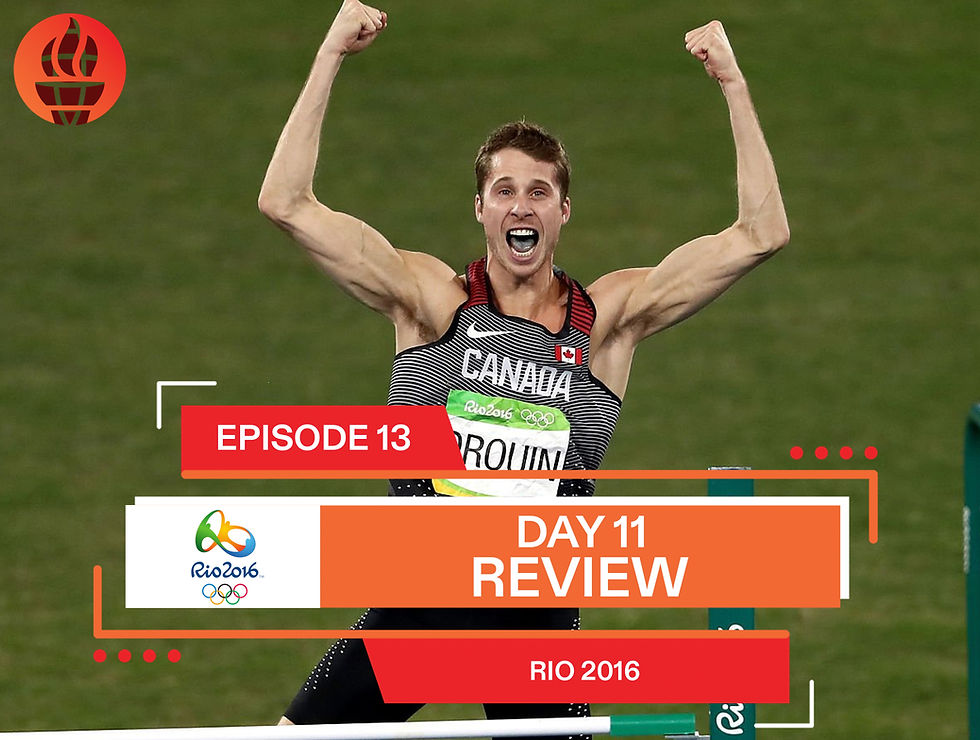
We're back with another amazing athlete interview as we speak with the reigning men's Olympic high jump champion, Derek Drouin! Derek gives us a rundown of what lead him to the unique sport that is high jump and just how he was able to make a name for himself both in Canada and the internationally over a fairly short period of time. He also goes into detail about the unique mental quirks and strategic element to the sport, as well discussing just how the delay to the Tokyo Games has affected him. We also get to the bottom of his love for Christmas and just why meatloaf isn't his thing.
EPISODE TRANSCRIPT
Please note this is an automated transcript that may contain errors.
COLIN HILDING: We are back on Off The Podium for another special athlete interview here as we're continuing our series here on Great Canadian Athletes. And we have somebody with a stacked resume to talk to you today. We have a former world champion, former Commonwealth Games gold medallist, former Pan American Games gold medallist, two time Olympian, one bronze medallist, and the reigning Olympic gold medallist in the high jump, Derek Drouin. Derek, thanks so much for joining us today.
DEREK DROUIN: Quite the introduction.
COLIN HILDING: Let's just pitch that for your introduction for 2021 in Tokyo. We could even just take our audio and just play it over the stadium.
DEREK DROUIN: I'd go for it.
BEN WATERWORTH: I'm also here too, by the way, guys.
COLIN HILDING: Oh, yeah, and Ben.
BEN WATERWORTH: No Olympic medals, no world championships, none of that. But I'm proud to be speaking to an Olympic gold medallist. That's my achievement.
COLIN HILDING: Derek, we always start off these interviews just by asking how you got into your sport of choice. And I could guess, like most Canadians, you know, there was track and field as a kid. So maybe your background was just high jumping and having some success elementary school or whatever. But if you want to go even further than that, how did you get into high jumping, I guess, competitively?
DEREK DROUIN: Yeah, so I mean, as a kid, I was quite fortunate. My parents were really encouraging and really just allowed my sisters and me to pursue really any any endeavours that we wanted to try. So at one point or another, I was playing basically every sport, any sport that you can name in elementary school. I did literally everything that was offered. Track and field was one of those sports. And I don't know that I would say that I fell in love with it more than any others. I just loved competing. So I got a little taste of track and field early on, but the time was still pretty committed to team sports. And I was a hockey player for literally my entire youth. But then as I got older, as my body started to change and I grew into the form that I have today, I usually say that high jump kind of chose me rather than the other way around. I often say that I decided or put into the universe at a young age that I wanted to be an Olympian. I wanted to be a professional athlete. I just had no idea what sport that was going to be. So at 10 years old, that was kind of the plan. That was the dream. And it took the better part of a decade for me to realise what that sport was going to end up being.
BEN WATERWORTH: Is it true that at one point when you discovered high jump, that you went and put a broom over a couple of speakers and used that to practise? Is that a true fact that I read?
DEREK DROUIN: That is a true fact. I mean, was basically trying to figure out a way to play any and every sport at home, you know, because I just couldn't get enough of it with one, you know, soccer game a week, or only getting to play certain sports in gym class. So I was always kind of trying to figure out a way to do things at home. High jump was one that I was able to get a little taste of at school and decided that I wanted more. So set up a little makeshift high jump pit in my parents' basement, where, you know, like you read, the broomstick was a crossbar. And I used speakers and a couple of books to sort of elevate that bar.
COLIN HILDING: Any really bad accidents? I mean, I know many times as a child, you know, horsing around in the basement, many things broken, lots of punishments. Was this with like the parents' permission or did you ever like, oh, I missed that one. There goes another broom.
DEREK DROUIN: I, you know, I don't remember any any really big accidents. I mean, I tried not to hit the broom, obviously, so I think I can say that those were pretty, pretty much unscathed. Again, I don't have, I don't have a ton of memory of doing it, but the situation, I will say, actually, I think lens or is probably the reason why I jumped from the left side of the pit, just because it was the sort of formation of the of the basement. But the other funny thing about it is I would have had to have been standing sort of in our downstairs living room area where my parents would have quite often been. So I'm sure that they knew what was going on and figured, you know, either it's going to be fine or he's going to hurt himself. He's going to learn his lesson. So I guess they were they were right.
BEN WATERWORTH: Did you also then have, you know, the the driveway hockey net and kind of a soccer net as well? Like, did you just kind of have almost like a complete sports arena facility at your house in every single possible corner you could have?
DEREK DROUIN: Yeah, pretty much. We are the driveway. Yes, we certainly had a a hockey net in the driveway. My dad would bring home plexiglass from his work that we could. It kind of serves as artificial ice, not to skate off of, but, you know, it's like shooting a puck off the ice. A basketball net in the driveway. There's a park literally across the street for anything like baseball or soccer that needs a little bit more room. So it was a pretty, it was a pretty ideal childhood setup in terms of athletics.
COLIN HILDING: I think in almost every interview we do, we get very similar answers like what you gave that, you know, you were just into all sports and it was just, OK, which one do you excel at? You mentioned that, you know, high jumping sort of shows you when you were growing up and you were thinking about, you know, potentially being an Olympian one day. Did you have another sport that you were really gunning for, thinking, oh, it would be incredible if I could, you know, be a gold medallist in this one day?
DEREK DROUIN: You know, I really I really don't think so. I remember specifically being really excited after watching the 2000 Olympics in Sydney. It's kind of that's usually I would say is the first games that I remember watching. I was I was 10 years old and I was just really, really. That's really when I fell in love with it. And I remember specifically kind of thinking about it and saying, I'm going to go to the Olympics one day. I just need to decide what sport. And I remember going through my head and thinking, OK, well, I play hockey. I definitely don't think I'm that good. I play soccer. I play X, Y, Z. And so I don't think at a very young age, I had decided what I thought this sport was going to be. It probably wasn't until midway through high school, I would say, that track and field really kind of started to set itself apart. And I realised that this was probably my best bet. It was probably, gosh, another four or five years before I even thought that the Olympics were in my wheelhouse. Track and field is a late entry sport by most accounts. So it's not super common that someone is 12 or 13 years old and shows that kind of promise or any sort of reliable promise that they're going to go to the Olympics. So, yeah, I remember even being in university, starting probably just my first year of university and not really knowing that this was a viable option or a viable career path.
BEN WATERWORTH: One thing I remember from high school and doing track and field and sort of clearly, I'm sitting here as a podcast host, never had any ability in that area. But when it came to doing things in the field and the track, high jump was one of those weird ones where I just, I didn't get it because I couldn't do the whole way. You've got to jump over the bar, right? The sort of the backwards motion. There was just something mentally that somehow I can't contort my body in that way. Did you ever have any, like, how do you adapt to that? I'm not trying to start a late, blooming career here, Derek. I'm not going to be challenging you next year at the Olympics by any means, but like how, yeah, maybe. But how do you kind of, how do you get into that mindset? Or is that just something when you're sort of talking about all these sports, it's not something that just happens. You just did it, and then eventually you just adapt that technique, and that's kind of what you become good at.
DEREK DROUIN: Yeah, so I think it's pretty, pretty common that track and field athletes, especially like pole molters and high jumpers, maybe more so on the women's side than the men's, but have a background in gymnastics, or at least some sort of, at least some sort of broad athletic background where they were able to learn body awareness at a pretty young age, which is super, super important in high jump. I've competed against a lot of guys that have far, far, far greater, just pure athleticism and a higher vertical jump than I do. But it's when you combine those two things, a body awareness and an ability to know where you are in space, and like you said, control your body over the bar, that really, I think, plays a huge role. So for me, I never did gymnastics, but I grew up, my parents have a pool, I was always trying to do different tricks, flips, things like that into the pool on friends' trampolines, things like that. So I think I developed that kind of body awareness at a pretty young age. And I had an older sister who was a world-class high jumper, is now retired. But so I was able to see her do high jump, realise this was something I was probably interested in. And so I was kind of exposed to the technique, the general rules, there aren't a whole lot of rules of high jump, but the general idea of how it's done at a pretty young age. So when I was practising in my basement, I was doing things, maybe not technically perfect, but I was doing them to the guideline or to the rules of high jump, meaning you can only jump off one foot. And really, that's basically the only rule. And that's one that when I coach little kids, it's a very hard concept for them to get. Many people want to jump off two feet, as do volleyball players who come to high jump, and very often basketball players as well.
COLIN HILDING: First of all, Ben, I'm so glad to hear you say the exact same childhood experience I did. Because when they were teaching us high jumping, I think in like third grade or fourth grade, I remember the teacher saying, Colin, I need you to stay behind after class. And it was literally, you are the worst one in the class at this. So I think the main thing like you mentioned about having to sort of jump backwards, it just feels so unnatural. I remember my gym teacher taught me what was called the barrel roll, which is basically like flying over like Superman. I was able to get a little bit more like that. But is high jumping something where everybody sort of just adapts their own form? Because you mentioned that you jump from the left side, maybe you're a little bit different than other high jumpers. We saw in Rio the same thing with Andre de Grasse. People commented on his running styles. It's different. It's unusual, but it works for him. Is high jumping something where it is very strict, this is how you do it, or can you adapt styles more the way you did?
DEREK DROUIN: I think there's definitely variation. Let's say 40 years ago, you could go to a different competition and see different styles, different ways of going over the bar. So you mentioned basically a barrel roll. That was a pretty common way to high jump 40 years ago until Dick Fosbury started going over backward. So there's been changes like that in the sport for sure. For the last 30 years, I would say everyone is using the Fosbury Flop, so everyone is going over backward. But if you go to a high jump competition, yes, like I said, I kind of grew into a pro-typical high jumper's body. A lot of guys look like me. I'm 6'5, quite lean. That's a pretty common body type. But there's also guys that one of my favourite high jumpers growing up is only about 5'10, and runs very fast to the bar. It's totally different from me. So there is that sort of variability. You can sort of pick and choose what works for you. I'm a firm believer in an athlete's body, kind of knowing what works best for them. And so not really, if you're coaching, not really trying to change things up too, too much to get everyone to fit into that sort of textbook mould. So for me, I jump a little bit differently than maybe the textbook, or a lot of my competitors would do. I think in Rio, it was kind of, in my opinion, it was sort of overblown just how different my approach is. But there are certain differences between one jumper to the next.
BEN WATERWORTH: I believe that approach. So while most people will run towards the bar at pace, yours is sort of more of a slower style and then bounding a little bit more towards bar. Is that correct? That's kind of the one that people were picking up on a little bit in Rio?
DEREK DROUIN: Yeah, so a lot of guys do. I mean, if you're looking at a textbook explanation or description, usually they would say basically run as fast as you can, that your body is still going to be able to handle, because I could run my 100 metre PB and then put my foot down and try to jump, and it's probably not going to go out so well, so it goes so well. So there's, you know, trying to find that balance. Typically, people would say you want to run as fast as you can handle. I just kind of found that for me, doing more of a bound, whether it's just getting my legs ready to react in a better way, it's setting myself up a little bit better for the jump. That seems like it's worked for me, you know, better than the full tilt, approach the bar has.
COLIN HILDING: You mentioned how you didn't really get into high jumping, I guess, more competitively until college, or that's where you really started to develop. But, you know, just looking at your, I guess, very quick ascent to the gold medal in Rio, really looking at only a couple of years there. And I mean, you had success, you know, world championships and even in London at a very young age. How quickly did this all come together for you? Because obviously every sport is going to be different. We talked to a lot of athletes where, like, oh, yeah, you know, you're waiting four years and then there's another four years for you to make the team. And it almost seemed to happen overnight, even though I'm sure it doesn't feel that way to you. You sort of just appeared on the scene and then were immediately in medal contention everywhere you went.
DEREK DROUIN: Yeah, so I had a pretty interesting trajectory, I should say. I did have a medial level of success in high school. I won a couple of Off The Championships, or Provincial Championships in Ontario. I competed once on our national team at the World Youth Championships when I was 17. So that was kind of leading into college, sort of what my profile looked like. It certainly didn't have Olympic prospects necessarily on the horizon. And I graduated high school the year of the Beijing Olympics. So that was certainly not, an 18-year-old boy competing in the Olympic track and field was quite rare. It certainly wasn't something that was on the horizon for me. So the next four years are obviously, it's the Olympic quadrennial. Those are really important years. So I experienced a pretty drastic growth there. When I went to university, it was the first time in my life that I was focusing on just one sport. I would say that it was a very late mature. So I really wouldn't, I would say that I didn't really hit puberty fully until I went away to university. And so there was a lot of factors that sort of came into play. There, for the first time, I was really kind of strength training. And so in 2009, that was my first year in university. And I actually jumped the Olympic standard, you know, just one year short of the of the Beijing Games. So I think from that point, it was kind of I was on that trajectory to make the Olympics. I was certainly, you know, at that at that level. And then it was kind of just a steady grind from there. But the reason why I wasn't really seen on this on this on the scene between 2008, 2012 is, you know, 2010, I was still I was still in university the entire time. So a university season is really, really draining. It's tough to compete in the summer. 2010 is kind of an off year in track and field. So I didn't compete at all that year. 2011 things were going really well. And then I ended up tearing a few ligaments in my foot and had to sit out all summer. So that's a reason why I wasn't at the World Championships. I wasn't in nationals, anything like that. So then next thing you know, it's 2012, the Olympic year again. And, you know, no one has really seen my name on a senior stage. It was, you know, literally the first time that I was ever on a senior national team heading to the Olympics. So I think my climb was pretty steady. I kind of always knew that 2012 was definitely within grasp, but I was doing so definitely behind closed doors, just, you know, given the circumstances.
BEN WATERWORTH: And what was that moment like then through all of that when you qualify for the Olympics going back to when you said you sort of fell in love with the Olympics back in 2000, and here you are 12 years later, you're going to be walking out there and representing Canada in the biggest sporting stage in the world.
DEREK DROUIN: Yes, it's it's it's surreal, truly growing up. And for the first 22 years of my life, I would watch the Olympics and think, you know, this is amazing. I'm just totally enamoured. I was totally in awe with these athletes. And you just at least for me, I didn't see myself like that. You know, I I always had this dream of going to the Olympics, but I don't know that I ever really, truly thought that that was in the cards for me because these athletes were just. Otherworldly, and so it was surreal when I I didn't know that this was something that I was on the trajectory for, but I think when it finally did happen, I thought. I don't know what I thought, you know, this is this is insane. I can't believe that this is actually happening to me.
COLIN HILDING: The experience in Rio is something that I found interesting, especially in following the media around the high jump event. I mean, obviously, you know, winning the gold is going to be a big deal in the Summer Olympics, especially, you know, for Canadians. But maybe because of Greg Joy, who I'm sure you're familiar with Greg Joy. Everybody in Canada is familiar with Greg Joy. The success that he had in Montreal, which in retrospect wasn't even a gold medal. I mean, it was more or less this was the best we did at the home games. And he just became so famous, maybe synonymous with the Summer Olympics over any other athlete for decades to follow. And then you come along and it's, I think, the highest placing that Canada had ever had, and let alone as a gold. Did you find there was a lot more attention on either the event itself going in or even afterwards, just because of how much Canadians associated Greg Joy and this sport with Canada?
DEREK DROUIN: That's a good question. I mean, high jump, it's no secret that high jump is a pretty niche sport, even in Canada where we've had a lot of success at the Olympic Games in the past. So I don't know that I would say that high jump had more attention than anything else, which I was fine with, I'm appreciative of. I would rather sort of go in under the radar and just be able to do my thing with not a ton of pressure. So I think that I benefited from having a super strong Canadian athletics team heading into Rio with many medal favourites, that the expectations and the pressure and the attention was dispersed amongst a good handful, if not more of us. So though I was excited and happy that Canadians were excited to watch High Jump, I don't think that I felt there was any extra or added pressure or attention than what was warranted.
BEN WATERWORTH: One thing I'd like to just quickly ask, and not gel too much on Derek's, I'm probably sure you're sick of talking about it. 2012, the gold medallist in that event, of course, has since been disqualified. They haven't reissued the medals there. You, of course, are in a three-way type of bronze, which in its own was a unique aspect. But I mean, what kind of is your thought on what should happen there? Is that something where if the guy who wins gets disqualified, you should kind of be bumped up to silver? And kind of, if that's the case, what's happening there? Have you heard anything recently about what may happen if you may get a silver instead of a bronze?
DEREK DROUIN: Yeah, no, I have not heard anything, basically, since the news came out almost two years ago now, that Ukav was being disqualified. I don't know what the protocol is like. Anytime where I see results from London now, it just straight up says, no gold medal awarded. For me, if I was the silver medallist in London, I would probably be much more anxious and much more I would be pushing for those reallocations to happen. Or if I finished fourth and was in line for bronze medal, I would probably be a bit more excited about it or a bit more... I would be pushing for it, I guess, a bit more. Given my circumstance that I was bronze and in the prospect of being bumped up to silver, I don't want to say that... For me personally, I think it's not a big deal. I think for the sport, it probably is important to show that cheaters are going to be caught. In the end, the right is going to be done. I truly feel for the silver medallist in London. I think he obviously deserves a gold medal. He deserves that recognition. But what he's lost in the last eight years cannot be replaced. So you can do so much to make amends, but only so much can be done.
COLIN HILDING: The thing that I remember the best about your win in Rio, aside from just the excitement of we won a gold medal, it was after you had already secured the victory. And this is the thing that I've never quite wrapped my head around all the rules of high jumping, but you get the opportunity to jump again. And depending on what network you're watching on, if you're watching on CBC, NBC, who knows what, there seems to be differing opinions on whether or not a jumper would go again. But for me, watching at home, I'm thinking, if you have another jump to go, even though you secured the medal, why wouldn't you go for it? I'm assuming you were just going to try to bump it up and maybe go for world record, Olympic record, whatever it is. Is there a reason why somebody wouldn't go for that? And what kind of led to your decision to, I want to jump one more time, even though I don't have to?
DEREK DROUIN: Yeah, so I actually in Rio could have jumped three more times. I elected to take just one because, I mean, in order to jump 240 or to jump any sort of Olympic height, it requires a lot of energy and it's also quite emotionally draining. So for me, when I found out that I won, I knew that it was probably going to happen. I knew that it wasn't looking good that the other jumper was going to make this bar. So when he misses, which he probably is going to, you know you're going to win, but you need to keep yourself in the mindset because you're jumping really well. I think I have a great shot at breaking the Olympic record today, and I want to take that shot. So when I found out that I won, I was really just trying as hard as I possibly could to, you know, don't celebrate me right now. You've got business still to take care of. So kind of trying to like shoe away cameraman to just keep everything, keep myself composed, keep everything in place to take this shot at the Olympic record. I often say that I almost wish that he had made that bar so that I could have taken three legitimate attempts at the Olympic record under some pressure or really meant something. But to be honest, that was really the only reason why I took the three jumps. I had already won. If it wasn't to sort of set a new Olympic record, I probably wouldn't have taken the other three jumps. So it's all kind of circumstantial whether you would take it or not. And it's not a super rare, or sorry, it's not a super common occurrence that somebody wins the Olympics by a height. So usually you don't see that. Normally we're kind of watching misses. If both athletes don't make it, we have to go back and look at the scorecard, which is always really exciting for the fans who don't really understand the rules to try to figure out.
BEN WATERWORTH: It's such you talk about the emotions, that emotional aspect of your sport, which is so unique because you're talking about there, watching your competitors miss. And it's kind of one of these sports where I guess deep down you are cheering for these guys to miss because, you know, you want to win. And to win, you need them to miss. Otherwise, you guys are going to be jumping all night. So I can imagine from that mental aspect and then also just that mental aspect of clearing the bar because at the end of the day, you need to jump over a bar to win, essentially. And I can imagine there's a psychological element to that because you might have a personal best. You might be the world record holder in the event. You're capable of jumping higher than anyone ever. But on a night, you just might not even be able to clear 2-2. And you just can't get over those mental demons. How much do you work on that mental ability as much as you are your physical ability when you go into an Olympic final?
DEREK DROUIN: Yeah, I think especially in the events like high jump and pole vaults, where it's really at its bare roots, you against a bar. And you are probably not going to end a competition on a make. You're probably not going to end a competition on this huge high, like winning a 100 metre race or having a huge throw like that. It's a different beast than the other sports, I think. So the mental aspect is super, super key. Like I said before, I think there's been plenty of times where I've gone into a competition, and I'm not the most athletic person out there. I'm not the best jumper even, but I think that my sort of mental fortitude and my ability to compete under pressure is what has sort of set me apart. And it is tough to train for that, because there's always, always different variables that come into play. No competition is the same. I've gone into competitions, the world championships, where I was the first jumper. So it was up to me to put the pressure on everybody else. I don't get to see what anyone else is doing. I might be finished my competition and have to watch to see everybody else miss, to see if I even landed on the podium. Or you can be the very end and get to see everyone else clear these bars, and now you're the last person it's up to you. So there's definitely a lot of things that come into play, a lot of things that you can try to work on. Unfortunately, I think at the end of the day, sometimes that mental fortitude is something that you either just have or you don't.
BEN WATERWORTH: And in terms of that too, the strategy involved in a sport like high jump, because as you're sort of saying, if you're the first one out there, you set the standard. But I remember you talk about Sydney falling in love with pole vault, because we had Tatiana Grigorieva, who very nearly took the gold for us that night for Australia and got the silver. So that's kind of where I'm learning sports like this, where it's that strategy of I'm going to start with this height and maybe I'll skip that height because I don't need to jump that height. I'll go to the next one. How much does that involve in sort of your preparations and how do you work out that strategy? Do you just go each subsequent jump or do you automatically go to a certain height because you just want to kind of start high and keep going from that point on?
DEREK DROUIN: Yeah, that's one thing that's kind of, you know, it's obviously different from athlete to athlete. When you get to an Olympic final, usually the... you start so high, at least for me, we start so high and the field gets dispersed fairly quickly. It gets thinned out pretty quickly. I generally don't find that it's worth it to skip a height. And I tend to warm up a little bit more as the competition goes, as I get some jumps under me. So for me, it's never really much of a question. I usually, you know, just jump every bar, try to make everything on my first attempt. At least that's plan A. If things aren't going quite so well, then I'll maybe decide to skip a bar here or there. But usually I'm not just skipping a bar to save energy, which is what some jumpers do, which is what the bronze medallist in Rio did, Bondarenko, from Ukraine. He tends to only jump every other bar because he feels that he is conserving energy, I assume. For me, the only time that I would really kind of skip bars or get into that sort of psychological play would be at the end of the competition. I'm in medal contention. Let's say I miss at 238, and my competitor makes it. I would then pass because I know I'm going to have to make the next bar to beat him anyway. And it doesn't matter whether I have 236 on my scoreboard or 238. I'm still going to get second place. So it's sort of tough to explain that in a short sentence. It's a little bit easier if I've got a pen and paper and can sort of explain a scorecard for you. But I know it's confusing, and there's often times where, even as high jumpers will talk about it, be like, well, who would have won in this situation? And I'm like, I don't know. I would have to see a scorecard. But typically, if I'm in a competition, I have a pretty good idea of what place everybody is in without having to see the scorecard.
COLIN HILDING: Obviously, between Rio and Tokyo, you made an interesting decision that you're going to, I guess, you can't say switch sports. I mean, you're still a track and field athlete, but now your focus is going to be for Tokyo, the decathlon, which boggles my mind that anybody can go out there and do countless sports in one Olympics. I got really into the decathlon at the last Olympics. Now, is this something where you have to choose to only do the decathlon, or are you going to be doing the decathlon and high jumping?
DEREK DROUIN: So that kind of depends on a few factors, really. One would be straight up on schedule if it is physically possible to do the two. I would say my goal in making that sort of training change wasn't so much at the Olympics. My goal was probably always to compete in the high jump at the Olympics. It was more as a secondary. I would have loved to have competed for Canada at some games, some sort of championship in the decathlon. So whether that's World Championships, Commonwealth Games, something like that. Just because I felt like that's why I was recruited to go to university to compete in the decathlon, and I did all through my five years. I graduated in 2013, so after the London Olympics, and I was still competing in the combined events to that point. And that's kind of when I felt my strongest. It's when I felt most confident competing because of that decathlon training. It was kind of my roots in the sport, and I wanted to stick with that. And it wasn't until after I graduated that I really started focusing on high jump solely. And it was really also the first time in my career that I was experiencing these sort of nagging injuries that often single sport athletes do or single sport athletes experience because they're doing the same thing day in and day out. So the decision to go back to my decathlon roots was more rooted in just wanting to be a more complete athlete and sort of avoid some of those injuries that I had had in the previous years. So at the Olympics, I don't know that I was good enough or could have gotten good enough to compete in the Olympics or really be competitive in the decathlon, but it was more as a training decision to just get back to my roots in the sport.
COLIN HILDING: Do you have, of all the decathlon events, do you have one that you consider to be your next specialty, like is it javelin or something else?
DEREK DROUIN: Easily. My next best is the hurdles. So I have competed at Canadian Nationals in hurdles. It was definitely my second strongest event in the NCAA. And given the way that the scoring system works in the decathlon, oftentimes I score almost as many points in the hurdles as I do in the high jump. So those two are pretty far and away my top two. The next, you know, I enjoy a lot of the sports. Javelin was one I did in high school and always had a decent level of success. So I will say those three are typically my top three.
BEN WATERWORTH: Are you just a guy that hates bars? You want to jump over a high bar, those hurdles? Like, I mean, you just got something against you scared of them or something?
DEREK DROUIN: Well, like I said, I don't think I've ever gone into a competition. I felt like I was the best pure athlete out there. So I think I always kind of need something to even the playing field. So hurdles is a good way for you to feel fast, or at least for me to feel fast and compete against really, really fast guys. But they would all kick my ass in a flat race.
BEN WATERWORTH: I'd love to just quickly go back to Rio. And again, those emotions, winning a gold medal. Again, Derek, I always like to live through our guests because it's something I'll never achieve. But I mean, clearly getting that moment where you're going to be an Olympic gold medallist, hearing O Canada and just kind of everything that came with that moment. I mean, is that something that you can put into words?
DEREK DROUIN: I mean, it's certainly going to be something that I won't forget. I oftentimes think more about that moment than even the actual competition in Rio. My only, I don't know how to describe it. The only thing that I would say I maybe was disappointed about the experience is, given the way that a high jump schedule, or sorry, the athletic schedule works at the Olympics, is I think I was one of the last people on the track that night in Rio. So they don't do the medal ceremony that night. So you go back the next day. So I had at that point had 24 hours to sort of process what had happened. I had seen, I hadn't seen my family, but I had seen my coach. I had seen my teammates in the village. It had become real that this had already happened. And I had thought about what's it going to be like standing on the podium, listening to the national anthem. So I wasn't quite as emotionally struck by standing on the podium as I wish that I had been. I often think that if we had just walked straight over to the podium right away, I would have just been on rank, which I kind of wanted, you know.
COLIN HILDING: For Tokyo, most of the athletes that we've talked to, obviously the cancellation of it, we got their reactions very soon after it was cancelled. I think you're the first one we've had on that still, I'm guessing, training to be there, but there's been that time to process. What's it like with training? Are you in the middle of training still? Does it seem like it could be a never-ending wait? Are we going to go to Tokyo in 2020? How do you actually, six months now down the road, how do you actually prepare for Tokyo, even with all the inevitables of whether or not it will happen?
DEREK DROUIN: I mean, it's certainly been... It's certainly been a year where you've been tested. If you have adversity, if you can roll with the punches. Right now, I think it's important for us to just kind of train as if the games are going on, but be very mentally prepared, I think, for the possibility that they might not. There are a lot of things in life that are just more important than sport. I know that it's tough for athletes who feel that sport is their entire life, to accept that. But, I mean, these are unprecedented times. So right now, we are still training as best as we. We were just able to get in a pretty solid block of uninterrupted training until just, I think, starting yesterday, Toronto has gone back into lockdown. So things are probably getting a little bit more tricky right now. So right now, we're basically just kind of dealing with things doing the best that we can. Training is what the Olympics are going on, but open to the very real possibility that they might not happen.
BEN WATERWORTH: I want to take this opportunity, Derek. This is something that we've not brought up before in the show, but Colin and I have talked a lot about it when we're actually covering games. I'm not saying this right now, you're going to win back to back gold in Tokyo. I've got that positive mindset. However, the slight tidbit with that fact is that whenever we get people on this show, they generally don't do that well at the next Olympics. So I want you to know that if you don't, but you will, you will win, I'm saying. But if you don't, you have every right to rip shit into us and basically blame us. I want you to know that post interviews on CBC, the first thing is I want you to be like, fuck off the podium. I shouldn't have gone on that piece of shit show. No one listens to it anyway. Fuck them, they cost me the gold.
DEREK DROUIN: I will write that down in a list of excuses to give.
BEN WATERWORTH: Please do.
COLIN HILDING: It's no joke. I mean, we interviewed Olympians where they were a shoe in. I think the top two mogul skiers going into Pyeongchang, like one of these two is going to win. Neither even won a medal. And then Charles Hamlin, I don't know if you're familiar with him. It was basically, OK, he's going to set the all time record for most medals won in Olympics, and he didn't win anything. And he was on the show beforehand. So we apologise in advance if that does happen.
DEREK DROUIN: You guys shouldn't tell people that.
BEN WATERWORTH: No, no, you've got to hang up on it, Colin.
DEREK DROUIN: A lot of athletes are.
BEN WATERWORTH: Maybe it's breaking the curse. Maybe it's kind of, you know, the commentary curse the opposite.
COLIN HILDING: We have to say it.
BEN WATERWORTH: One thing. Well, I love going through your Instagram, Derek, and kind of, you know, seeing you had some good times in Australia, it seems. That's great. Throwing first pitch at a Jays game after the gold medal one here. But I've gone back a few years here as we're approaching Christmas. I feel this is a bit appropriate. Seemed like you're a bit of a fan of Rudolph, the classic Rudolph show. And also you've got a sweater here, an elf sweater from several years ago. Is that still around? You're going to get that out in a couple of weeks for Christmas?
DEREK DROUIN: I think that I know what sweater you're talking about. And it was basically just a last minute arts and crafts type thing for an ugly Christmas sweater party. I do think that it's still hanging in my closet, but I have not seen it since probably the day that I posted that.
BEN WATERWORTH: I feel you need to dust it off and take it and put that on the gram, because I think your fans would love that. It's a pretty sexy sweater.
DEREK DROUIN: We shall see. It probably has fallen apart.
BEN WATERWORTH: Yeah. I just started to jump in, Colin, as well. Have you ever, when you did wear it, this is before the gold medal, but maybe does have put the gold medal around? I don't know what you do with the medal, but I mean, that would complement the gold medal very well, I feel.
DEREK DROUIN: I could probably at least test that out.
COLIN HILDING: I have to say, I'm a huge fan of the Rudolph Special as well. I mean, I'm obsessed with that. And I have a four-year-old and then we have twins who are a year old. And I think this is the third year in a row I've tried to show it to my oldest son. And he will watch anything else Christmas, like Frosty, Charlie Brown. Has no interest in Rudolph. Die hard. Yeah, exactly. I'm waiting for the day. And we showed it to him the other night, and I was telling my wife, I'm like, they're not liking my show. Like, what's wrong with it?
DEREK DROUIN: Oh, it's the best. I would still to this day say that it's my favourite Christmas movie. I just think that kids, I think it's tough for them to appreciate the sort of claymation, you know, movies, given how realistic cartoons can look now. Even, you know, I watch it once a year, and every time I'm like, gosh, this is so bad, but it's so, so good.
BEN WATERWORTH: Brilliant, brilliant. We're going to wrap it up with My Name Is My Favourite Question of Any Interview whenever we have a medallist on the show. Derek is, yeah, finding out what you do with a medal, like is it in a sock drawer or do you have it on display? And also, have you ever tried to use it for freebies? Like if you've wrapped it around the neck and walked down to the local store and said, hey, Olympic gold medallist, I'll have that for free, thanks.
DEREK DROUIN: I have absolutely never done the latter. I was just the other day listening to Brittany McLean's episode where she said, I don't know if it's a swimmer thing, but usually swimmers take their medal off as soon as they're, you know, back sort of under the stands or out of sight. I maybe I've got some swimmer in me because I'm, you know, pretty similar in that sense. So I do have it on display. I do, you know, I like any opportunity to, you know, bring it to speaking engagements or bring it to, you know, similar activities like that. Not because I like showing it off, but it's, you know, it would have meant a lot to me as a kid seeing an Olympic medal in person, being able to touch it or put it on. So, you know, more than I definitely, I would say that there's not sort of any enjoyment that I get being like, look at this, I won this, but it's more seeing people's eyes light up or seeing how excited they are to see it. So it is on display. Usually, I mean, the people that are coming to my house are friends and family who couldn't care less anyway, but any opportunity to show people that I know it's going to make their day or it's going to mean a lot to them, I like to have it on display for that.
BEN WATERWORTH: And does the poor bronze medal get ignored now that you got a gold? Like, does that just sit in the soft drawer now?
DEREK DROUIN: No, you know what, I am super proud of the bronze medal. I just had such different experiences, just such different lead ups to those two games. They're really on a parallel for me. I'm almost just as proud as the bronze medal as I am. Obviously, the gold one's a little shinier and a little prettier, but they're right next to each other on a display shelf. They're on the same level.
COLIN HILDING: So we got to go through our My Name Is series here. Now, we mentioned to you off the air that we asked this to all the people. And you said you vaguely remember filling these out in the past, but we couldn't find it on the site. So we're looking forward to Tokyo to see if your answers do match, because I mean, guaranteed they're going to put you as one of the athletes up there. Ben, you've got one lined up here. Who are you using as the base?
BEN WATERWORTH: The base for this one, and I've gone completely different games. I haven't even gone a summer athlete. I've gone a winter athlete here, Derek. I've gone with hockey silver medallist Laura Stacey from Pyeongchang. So, not sure if there's any winter theme ones here that we might have to alternate. But we'll start off with, what is your favourite Olympic moment? And let's say you can't answer yourself winning either of the medals.
DEREK DROUIN: So, like I said, the first games that I remember watching was the Sydney Games in 2000. So, for me, I watched Simon Woodfield win gold in the triathlon there. And I was not a swimmer. I had never, you know, I mean, I had ridied bikes, but I had never been like a cyclist. But for me, that was just the coolest, the coolest experience. I was so excited watching this new sport that I had never really heard of. And to this day, I usually would say that that was my favourite.
BEN WATERWORTH: I remember watching that vividly. I was 13, and obviously, you know, Australia just gripped by the Olympics, so we're all obsessed. But that was, I think, day two or day three, because Women's was the first, because McKaylee Jones got a silver for Australia. And I remember going, oh, wait, you know, Australia, we're great at triathlon, we'll win something in this one. And even before I lived here, I was obsessed with Canada. So to me, if Australia didn't win, I was cheering for Canada. So yeah, I remember that very, very well. Colin, do you want to take the next one, or do you want me to just keep going this? We've planned this very well, as you can see, Derek.
COLIN HILDING: I pulled up a summer one, we can kind of alternate.
BEN WATERWORTH: Mix the questions up, they might be completely different, who knows?
COLIN HILDING: Let's have you pull up another one, because I think I lost mine.
BEN WATERWORTH: You think we'd edit this out, Derek, but as you can tell, we're very professional. If you could have a superpower, what would it be?
DEREK DROUIN: Teleportation.
BEN WATERWORTH: Ah, nice. That is a good one to have. More people need to use that one. What is your favourite sports movie?
DEREK DROUIN: My favourite sports movie? I like Miracle. But I also like The Sandlot.
BEN WATERWORTH: Yep.
DEREK DROUIN: Or the classics. I think I'll have to give the nod to Miracle.
BEN WATERWORTH: Is there any high-jumping movies out there that we should know about? Are they waiting to make the story on you, Derek? Perhaps that's kind of going to be the first one.
DEREK DROUIN: Honestly, that does not sound interesting to me.
COLIN HILDING: I have one here. Oh, there goes my test.
BEN WATERWORTH: That's all right. Just everyone letting you know that Canada is in a state of emergency, apparently. Yeah, exactly.
COLIN HILDING: I actually pulled up Javelin athlete Liz Gledal here. Are you familiar with Liz?
DEREK DROUIN: Of course, yep.
COLIN HILDING: All right. I'm going to give you a question here, which I don't think is on Ben's. If I could choose an Olympic host city, it would be?
DEREK DROUIN: Athens.
COLIN HILDING: Nice.
DEREK DROUIN: I mean, I know they've been the host city, but I would have loved to have competed. The athletes I got to compete in Sydney and Athens, back to back, the jealousy is indescribable.
BEN WATERWORTH: One of your pictures on Instagram I see in front of the Opera House, so a bit of a fan of Sydney?
DEREK DROUIN: Well, since watching the games in 2000, I've been obsessed. Those two cities were kind of my lifetime goals to get to, and I've been to both multiple times and loved them just as much as I knew that I was going to.
BEN WATERWORTH: Do you take opportunities, or maybe I'm just an idiot who does this, when I go to Olympic cities, to visit Olympic sites or kind of find like a plaque or something that kind of signifies that the Olympics were there?
DEREK DROUIN: Yes. I mean, I've been to Sydney a lot more than I've been there multiple times, and when I'm there, train in the Olympic Park. So that one's definitely a cool experience for me. But anytime that I've been to Athens, it's been important to see, not just the original Olympic Stadium, but to see the more modern Olympic Stadiums. And then other than that, most of the time when we're competing at Diamond Leagues in Europe, it's in an Olympic Stadium. So I do get that opportunity quite often, fortunately.
BEN WATERWORTH: On that Weed Geek, every single time I go to Vancouver, basically a must is I have to get a photo in front of the cauldron. I mean, it's literally right there near the train station anyway. But look, it's kind of like, oh, I'm here again. May as well do it.
COLIN HILDING: I've got mine from Calgary behind me right now.
BEN WATERWORTH: It's on display. And Colin peed on the Calgary logo, so Colin did even more than that.
COLIN HILDING: Long story. I was a child and I didn't know what it was, and an older cousin said, the bathrooms are closed. Let's go here.
DEREK DROUIN: Oh, man.
COLIN HILDING: Benj, you got another question?
BEN WATERWORTH: I'll let you calm down after embarrassing you. What's your favourite pump up song? Is a pump up song something you have as a high jumper? Like can you kind of have a blaring over the speakers, getting you ready as you clap them with the crowd, getting them to get behind you?
DEREK DROUIN: We do often have, if there's high jump only meets, which are some of my favourite competitions to go to, usually they will ask you to pick a song and they'll play that song when it's your turn. So basically in lieu of announcing Derek's up, they'll just play your song, and that's kind of when your minute starts. So I take it pretty seriously choosing a song. You know, I need something that... It's a fast enough beat that you can clap to. It gets going right away to get the fans into it, but I do change it up every single... every competition. So I've always got a list in my phone of possible songs to use. So I would say the last song that I used, and he's a pretty... he's a staple on the list, was 24K by Bruno Mars. But I've used Bruno Mars songs a lot. I need him to come out with a new album with a suitable...
BEN WATERWORTH: Come on, he's been listening to the show, Bruno. So he'll be dropping something.
DEREK DROUIN: He should be listening.
BEN WATERWORTH: Yeah, exactly. Exactly. He's a fan of yours. What's the most recent TV show that you binge watched?
DEREK DROUIN: The Queen's Gambit.
BEN WATERWORTH: Do you enjoy it? Was it a favourite?
COLIN HILDING: Amazing.
DEREK DROUIN: I did enjoy it. I was that little kid that... I was always asking my parents to play chess with me. I was in... I don't know that I would say it was in chess club, but we had a sort of... My school would do a chess tournament. We'd sort of choose... The winners would get to go to the citywide tournament. And so I always looked forward to that. I was not very good. I mean, I was a kid who could play chess, so that kind of already sets you apart from the majority of kids, but that was about where my chess prowess ended.
COLIN HILDING: I watched the show as well. I mean, it's probably the only thing I binge watched all year, because typically I get tired after one or two episodes. But I was exactly like you. Like, I love chess, that as an adult, I would carry a chessboard with me everywhere I went. Does anybody want to play chess? But I may be the worst chess player in the world. So you could probably take me if we actually played chess.
DEREK DROUIN: Well, that's the only way to get better, to carry a chessboard everywhere.
COLIN HILDING: Yeah, well, you think, but I never got better. I've got a question here. I don't think we've ever asked this one before, and it's actually quite interesting. The weirdest instruction a coach ever gave me was?
DEREK DROUIN: The weirdest instruction? That's funny. So I've been working with my coach for the last 12 years. I've only had two hydrogen coaches in my life. And so we're pretty much always on the same page. I don't know that they've ever really given me any weird instructions. One, though, that I will say that I hear a lot from other, when I'm in competitions and I hear coaches say to other athletes, is just move back and run faster, which isn't really that weird. It's just kind of the staple. And I hardly ever agree with it. But it's just if you are around a high jump competition, you're going to hear those words.
COLIN HILDING: I mean, it's almost like telling somebody who's doing hurdles, jump higher.
DEREK DROUIN: Or a high jumper. Do the exact same thing, but just jump a little higher. Actually, you know what? That's probably it. I've probably had someone say that, do exactly what he just did, just jump a little higher.
BEN WATERWORTH: Which is kind of, you know, any sports like that, isn't it? Like, you know, where I'm from, football, Australian football, it's kick it, pick it up, kick it. It's like, well, what the fuck do you think they're out there doing? Like, I mean...
DEREK DROUIN: Thank you. Thanks for all of that.
BEN WATERWORTH: Yeah, exactly. Everyone in that game just looks, oh, thanks, guys. Really, I wasn't unaware of exactly what I was out here to do. What is your... We often talk about favourite foods, but let's go the opposite direction. What's your least favourite food?
DEREK DROUIN: Man, well, it's funny. I tell the story, well, not really a story, but whenever people talk about meatloaf, I remember one time as a kid being like, asking my mum, can we have meatloaf? Like, I love meatloaf. And she's like, really? I don't remember you liking meatloaf, but sure, I'll make it. And then she made it. And then when I saw it, I said, oh, I know I meant pot roast. I like pot roast. And I did not like meatloaf. And I still, it baffles me whenever anyone says, they love meatloaf. 75% of the time, people will say, you've never had my mum's meatloaf, which is the most annoying answer because meatloaf is meatloaf to me. But I would say that's probably the least favourite.
COLIN HILDING: I've got one more really good question here, and I'm hoping you're going to give the answer that I would give, as any good kid from Ontario might give. As a kid, my favourite sports team was?
DEREK DROUIN: You're from Winnipeg?
COLIN HILDING: I'm from Winnipeg, but it's not a Winnipeg team.
DEREK DROUIN: Okay, well, I'm sure it's not the answer. My favourite sports team was the Detroit Red Wings.
COLIN HILDING: I was crossing my fingers for the Leafs, but Red Wing's still good.
DEREK DROUIN: I grew up about an hour from Detroit, so my town is pretty much split down the middle between Red Wing's fans and the Leafs fans, but my house was not divided. It was Red Wing's house.
COLIN HILDING: I mean, mid to late 90s Red Wings, there's really no team in history like that.
DEREK DROUIN: Right. It was, I mean, now they're not terribly fun to watch, but I saw four Stanley Cups, I think, in really my formative years before I went away to university, so they were tough to beat.
BEN WATERWORTH: Tell Colin what's it like to see a team in a Stanley Cup. Colin, it's been a while for your guys, 40, 50 years?
COLIN HILDING: You know, I root for the Leafs, and I live in Winnipeg. I don't know what a Stanley Cup even looks like.
BEN WATERWORTH: I'm Australian, I have two teams. At least my teams have won one each in their lifetime, so that kind of works.
DEREK DROUIN: Well, when you have two teams, you've got pretty good odds.
BEN WATERWORTH: Yeah, well, I mean, when you grow up in Australia, your hockey viewership is very limited, so when you're exposed to the Mighty Ducks, you're kind of guaranteed to go for one team, and then you've got to choose a Canadian team, and therefore I love the movie Cool Runnings, I love Bret Hart as a kid, and therefore Calgary just seemed to make sense. And when I say I've seen them when I was two years old when they won the Stanley Cup, so I technically haven't. I saw them get robbed of one in 2004, but that's another story. Derek, it's been a lot of fun to have you on the show and learn everything about this and the unique sport that is high jump. You're our first high jumper on the show, so it's always fun to get a new sport on the show, and we thank you and wish you all the best of luck for Tokyo and break the Off The Podium curse. Derek, go out there and win that gold. Bring it back. Double gold medallist, Derek Drouin. That would be a fantastic thing to say in about 12 months' time.
DEREK DROUIN: My fingers are crossed. Thanks so much for having me, guys.
Comments